


Preloader

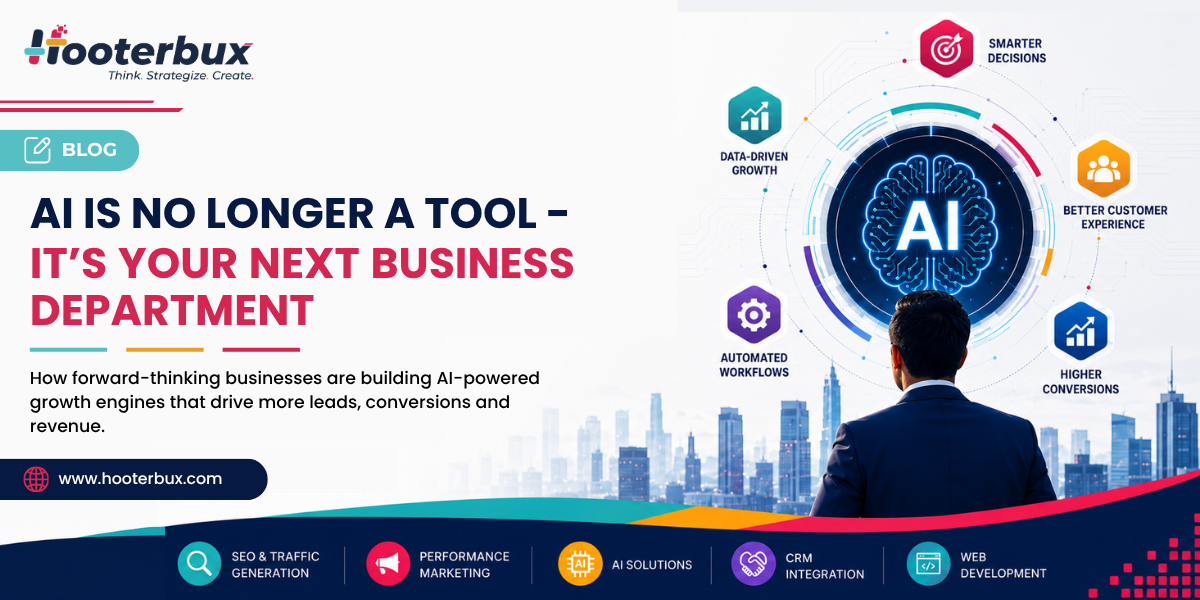
AI Is No Longer a Tool—It’s Becoming Your Next Business Department

For years, businesses viewed artificial intelligence as another software upgrade. A chatbot here. A content generator there. A few automation workflows to save time. But something has changed.

The companies growing the fastest in 2026 are no longer using AI as a tool. They are treating it as an operational department inside their business. Just as organizations once built dedicated sales, marketing, finance, and customer support teams, they are now building AI-powered systems that work alongside every department.

The Result?

The businesses that understand this shift early are creating a competitive advantage that becomes harder to replicate every month.

The Real AI Revolution Isn't Automation

Most discussions around artificial intelligence focus on automation. While automation is valuable, it is only the first stage of transformation. The bigger opportunity lies in augmentation

Instead of replacing human effort, AI amplifies human capability. Consider a marketing team. Traditionally,
launching a campaign requires:

Today, AI can accelerate each of these functions while human experts focus on strategy, creativity, and decision-making.

Businesses are no longer asking how AI can replace tasks. They’re asking how AI can make every employee ten times more effective. 

Why Traditional Growth Models Are Breaking Down

The digital landscape has become more competitive than ever. Advertising costs continue to rise. Consumer attention continues to decline. Customer expectations continue to increase.

Many businesses are attempting to solve these challenges by increasing budgets. The smarter businesses are increasing intelligence instead.

AI allows organizations to:

Growth is no longer determined by who spends the most. It is increasingly determined by who learns and adapts the fastest.

The Emergence of the AI-Powered Growth Engine

Forward-thinking companies are creating what can best be described as an AI-powered growth engine.
This system combines:
Growth is no longer determined by who spends the most. It is increasingly determined by who learns and adapts the fastest.

Data Intelligence

Every click, inquiry, purchase, and interaction generates valuable business insights. AI helps businesses transform raw data into actionable decisions.
Marketing Intelligence

Modern marketing requires continuous optimization. AI can analyze campaign performance, identify opportunities, and uncover audience patterns that would otherwise go unnoticed.

Sales Intelligence

Sales teams can prioritize leads, automate follow-ups, and predict buying intent with significantly greater accuracy.
Customer Intelligence

Businesses can understand customer needs before customers explicitly communicate them. This enables proactive engagement and stronger retention.

Search Is Entering a New Era

For nearly two decades, SEO focused primarily on search engine rankings. That reality is evolving. Consumers increasingly ask questions directly to AI assistants instead of browsing multiple websites.

The goal is no longer simply ranking on search engines. The goal is becoming a trusted source that AI systems can confidently reference.

To achieve this, businesses must focus on:

The organizations that build authority today will dominate discovery tomorrow.

Human Trust Is Becoming More Valuable Than Ever

Ironically, as AI-generated content increases, human credibility becomes more important. Customers are becoming better at recognizing generic content.
This is why businesses should avoid publishing content simply because AI can generate it. Instead, they should use AI to strengthen expert-driven content. The future belongs to brands that combine machine efficiency with human authenticity.

What Business Leaders Should Focus on Right Now

The companies seeing the strongest results from AI adoption are focusing on five strategic priorities.

Invest in Proprietary Knowledge

AI models have access to public information. Your edge comes from unique customer insights and business intelligence.

Strengthen Digital Infrastructure

CRM, analytics, automation, and tracking become exponentially more valuable when integrated with AI.

Build Systems, Not Experiments

Market leaders create connected ecosystems that improve operations across departments — not isolated tool tests.

Focus on Revenue Impact

Measure lead quality, conversion rates, retention, revenue growth, and operational efficiency — not tool adoption.


The Future Belongs to Businesses That Learn Faster

Every major business era has rewarded a different advantage.
Organizations that continuously learn, optimize, and evolve will outperform competitors regardless of size. The next generation of market leaders is already being created — not through bigger budgets, but through smarter systems.

Final Thoughts

Artificial intelligence is no longer another technology trend. It is becoming a core business function. Companies that treat AI as a strategic growth department rather than a collection of tools will gain significant advantages in marketing, sales, customer experience, and operational efficiency.

The question facing businesses today is not whether AI will change their industry. The question is whether they will lead that change — or struggle to catch up.

Businesses that combine human expertise, strong strategy, and intelligent systems will define the next decade of growth.